
What if reaching more learners does not require changing the destination—but creating more ways for students to get there?
Educators from across the country explored this question during ADAC’s Summer Learning Series webinar, Universal Design for Learning: Start the Year by Designing for All Learners. Led by Kaitlyn Weston, ADAC Director of Instructional Coaching and Program Quality, and Julie Cantillon, Ph.D., ADAC Senior Vice President for Professional Learning, the interactive session introduced participants to Universal Design for Learning (UDL) and practical ways to anticipate learner variability before a lesson begins.
One Goal, Different Experiences
The session opened with a deceptively simple challenge: participants had one minute to list as many uses for a paperclip as possible. However, each person received a different “hidden rule” that shaped how they could complete the task.
Although everyone was working toward the same goal, some participants faced greater barriers than others. The activity prompted feelings ranging from confidence and creativity to frustration, anxiety, and self-doubt—mirroring what students may experience in the classroom.
As Kaitlyn explained:
“We all had the same goal, but we all had a different path—and some of those paths were harder than others. That’s learner variability.”
The experience illustrated one of the central principles of UDL: firm goals with flexible means. The learning goal remains rigorous and standards-aligned, while students are given multiple pathways for reaching it.
“Today is not about lowering the goal. It’s about designing more paths with fewer barriers to reach it.”
Fix the Environment, Not the Learner
Throughout the session, participants examined a foundational UDL mindset: barriers often exist within the design of the learning experience—not within the learner.
An infographic shared during the webinar captured this idea with the phrase, “Fix the environment, not the flower.” One participant described the image as “a wonderful connection in the classroom.”
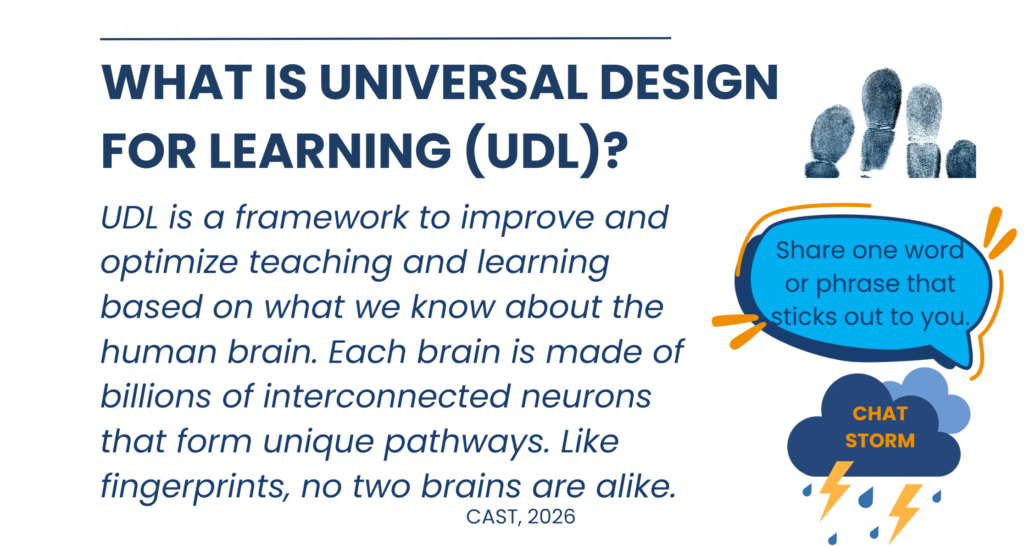
Educators also considered the idea that there is no “average” brain. Every learner brings a unique combination of strengths, needs, interests, experiences, and preferences into the classroom.
When participants were asked which core UDL belief resonated most, half selected:
“Learner variability is the norm.”
This mindset encourages educators to move away from designing lessons for an imagined “typical” student and then making adjustments when a learner struggles. Instead, UDL invites teachers to anticipate differences from the beginning and design learning experiences that are more accessible from the start.
Growing Confidence Through Practice
The session did more than explain UDL—it modeled it.
Participants could contribute by speaking, writing in the chat, using Zoom reactions, adding ideas to a collaborative whiteboard, or reflecting privately in their participant packets. These options demonstrated a simple but powerful UDL strategy: providing multiple ways for learners to engage, participate, and express what they know.
Early in the webinar, participants completed a “fist-to-five” confidence check on their ability to define UDL. As the session progressed, they applied the framework to student profiles and a sample lesson, practicing how to recognize learner variability, identify potential barriers, and recommend instructional changes.
By the end of the session, participants demonstrated increased confidence in applying UDL concepts to real classroom situations. Educators who began with an introductory understanding were soon identifying barriers and suggesting purposeful, practical ways to provide greater access for learners.
Low-Lift Strategies with a High Impact
Participants worked together to identify supports for a student with ADHD who benefits from movement and may have difficulty keeping track of multi-step directions. Their ideas included:
- Incorporating movement and brain breaks
- Providing visual directions and checklists
- Breaking instructions into manageable steps
- Assigning meaningful roles during group work
- Using whiteboards and hands-on activities
- Providing opportunities for partner discussion and processing
- Offering multiple ways for students to demonstrate their learning
While these strategies may be introduced with one learner in mind, they often improve the learning experience for many students.
This broader benefit is sometimes described as the “curb-cut effect.” Curb cuts were originally designed to improve access for people using wheelchairs, but they also benefit parents with strollers, travelers with luggage, delivery workers, and many others. In the classroom, closed captions, visuals, audio resources, flexible seating, and voice-to-text technology can have a similarly wide-reaching impact.
One educator reflected on using this approach in the classroom:
“I often used art or creativity to try to bring out that child—but I did it with the whole class.”
The reflection captured the spirit of UDL: when supports are designed with learner variability in mind, they can create richer opportunities for everyone.
Start Small and Design Intentionally
Universal Design for Learning is not a checklist, a last-minute accommodation, or a lowering of expectations. It is an intentional approach to lesson design grounded in the belief that every learner can work toward meaningful and rigorous goals.
Many educators are already incorporating elements of UDL through modeling, visuals, student choice, structured collaboration, movement, and accessible technology. The UDL framework helps teachers use those strategies more proactively and purposefully.
As educators prepare for the new school year, they can begin by asking one question:
Where might learners encounter friction in this lesson—and what small design change could remove that barrier before it appears?
Small refinements can make a meaningful difference. When educators design for variability from the start, they create learning environments in which more students can participate, grow, and succeed.
Watch the Recording
Couldn’t attend the live session—or want to revisit the learning? Watch Universal Design for Learning: Start the Year by Designing for All Learners.
Recording passcode: pk9Xfce&