
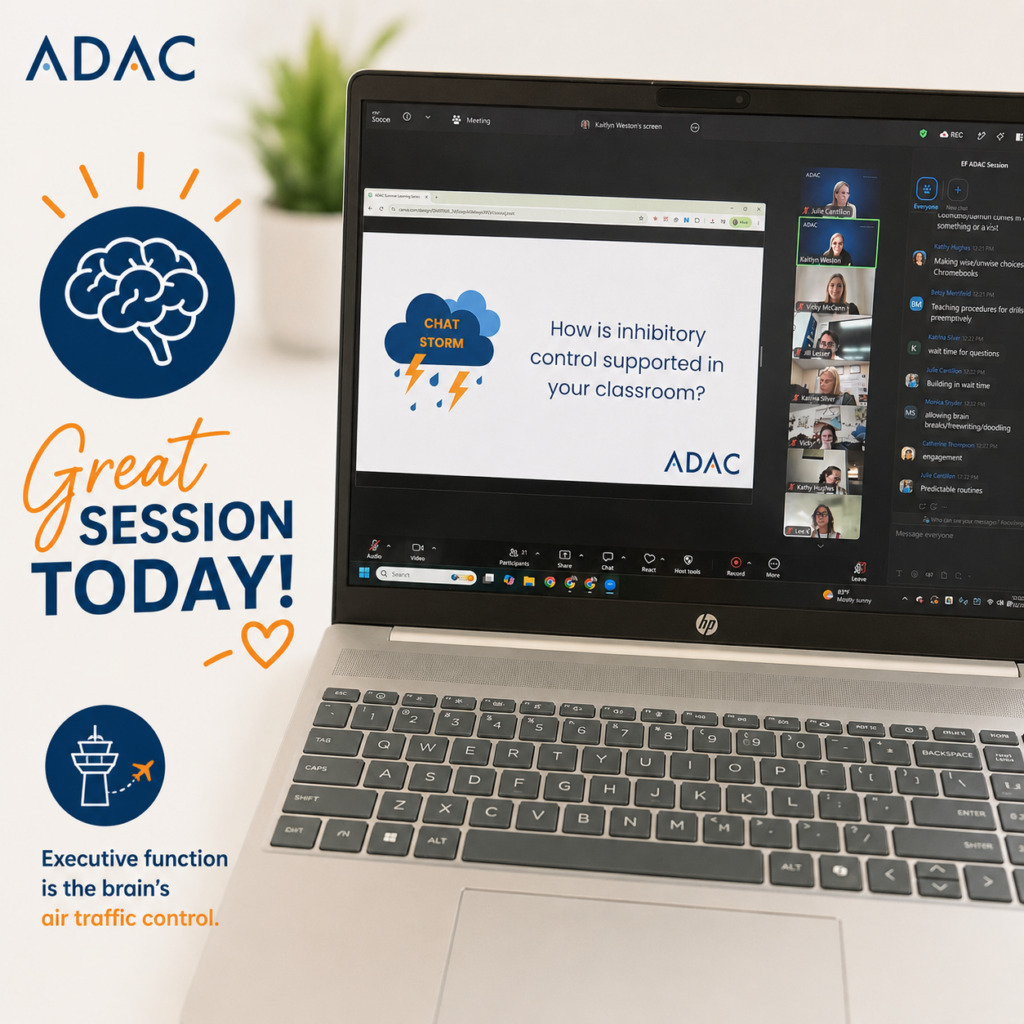
As educators prepare for a new school year, they are thinking about more than curriculum and classroom setup. Students also need skills to remember directions, shift between tasks, manage distractions, organize their thinking, and work independently.
Those skills were at the center of ADAC’s latest Summer Learning Series webinar, Executive Function Skills Every Teacher Needs This Fall, facilitated by Kaitlyn Weston, Director of Instructional Coaching & Program Quality, with Dr. Julie Cantillon, Senior Vice President of Professional Learning.
The interactive session helped educators better understand executive function and identify practical strategies they can use immediately with students.
The Brain’s Air Traffic Control System
The session began with a game of “What’s Missing?” Participants had just seconds to study an image, remember its details, and identify what changed.
The activity gave participants a firsthand experience of the mental work students are asked to do throughout the school day.
“Noticing and holding on to details and staying flexible when things shift—that’s exactly the kind of mental work that our students are doing all day long,” Weston explained.
Using an analogy from Harvard University’s Center on the Developing Child, Weston described executive function as the brain’s air traffic control system—managing multiple pieces of information, decisions, distractions, and actions at once.
Participants explored three core executive functions:
- Working Memory — The Post-it Note: Holding and using information for a limited period of time.
- Cognitive Flexibility — The Gear Shifter: Shifting between information, tasks, ideas, perspectives, or changing circumstances.
- Inhibitory Control — The Brake Pedal: Pausing, filtering distractions, managing impulses, and directing attention.
These skills show up constantly in classrooms—from following multi-step directions and transitioning between activities to staying focused after an interruption.
Looking at Classroom Moments Differently
One of the session’s most important takeaways came as educators worked through common classroom scenarios: students forgetting directions, struggling to remember what they read, becoming stuck on one approach, or repeatedly calling out.
Weston encouraged educators to consider what might be happening beneath the behavior:
“Every one of these is an executive function moment, not a defiance moment.”
That shift in perspective helps educators move from simply reacting to a behavior to identifying the skill a student may need help strengthening.
Making Good Strategies More Intentional
The encouraging news for educators? Many are already supporting executive function every day.
Teachers chunk directions, use visual supports, establish routines, model thinking, provide wait time, reduce cognitive overload, and help students set goals.
The key is becoming more intentional.
“What today is really about is doing it with even more intentionality—doing it on purpose,” Weston said.
When teachers understand which executive function a strategy supports, they can better match the strategy to the student’s need. Even more importantly, they can name the strategy for students so students begin to understand why it works and eventually learn to use it independently.
Participants also explored ADAC’s Executive Function Strategy Cards, featuring classroom-ready strategies including chunking tasks, using visual supports, building routines, modeling thinking, encouraging self-talk, making time visible, and promoting goal setting.
These practical supports reflect ADAC’s broader approach to executive function professional learning: helping educators embed research-based strategies into everyday instruction without simply adding another program to the school day.
What Educators Had to Say
Participants left the session ready to apply their learning.
“I really liked how this workshop was interactive, using common scenarios that we, as teachers, experience everyday with our students to help us better understand how challenges with executive functions can impact learning.”
Another educator shared:
“Excellent session—concise, informative, engaging, and well-organized. I plan to help our teachers understand the 3 executive functions and use the strategies intentionally, based on individual students.”
And another summed it up simply:
“This training offered great insight and tools to assist learners.”
Continue the Learning
Whether you joined us live or are discovering these resources for the first time, you can continue the learning with the webinar recording and free classroom-ready strategy cards:
Watch the Webinar Recording
Passcode: R13IXh^V
Download the Free Executive Function Strategy Cards
Supporting Students as the New School Year Begins
As students return to classrooms, executive function provides educators with another lens for understanding how students learn—and where they may need support.
The goal is not simply to provide strategies for students, but to help students recognize and eventually use those strategies for themselves.
As Dr. Cantillon shared at the close of the webinar:
“This is just the beginning of how ADAC helps schools to support students develop these executive function skills.”
ADAC offers customizable executive function professional learning for Catholic schools, (arch)dioceses, and networks, including virtual and in-person workshops, grade-band sessions, online learning, and schoolwide implementation options.
When educators understand the skills behind a classroom moment, they can choose more intentional supports—and help students become more focused, confident, and independent learners.
Interested in bringing executive function professional learning to your school or (arch)diocese? Connect with ADAC to explore customizable options for your educators and students.