
How can science educators make learning more accessible to every student while preserving the thinking, curiosity, and rigor that make science meaningful?
That question guided ADAC’s recent webinar, Making Science Accessible to All Learners: A UDL Webinar for Middle School Science Teachers.
Rather than simply talking about Universal Design for Learning (UDL), ADAC Consultant and former middle school science teacher John Spiegel invited educators to experience it.
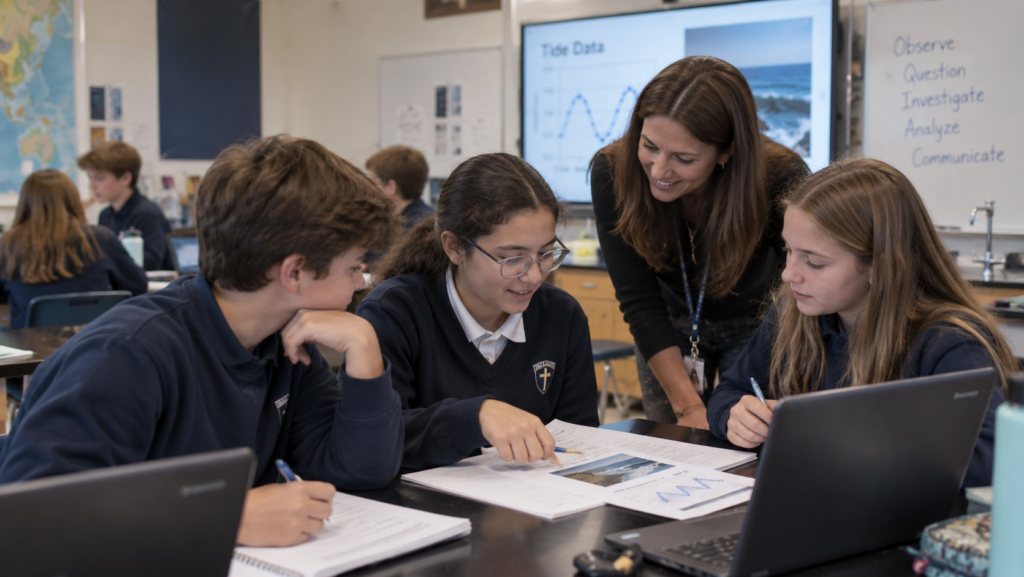
Using photographs of a changing California shoreline, participants began by noticing, wondering, and developing initial ideas. They then examined real tide data, identified patterns, connected those patterns to evidence, and revised their thinking as new information emerged.
The experience modeled an important idea: making learning accessible does not mean making the learning easier.
Reduce the Barrier — Not the Thinking
After experiencing the lesson as learners, participants stepped back to examine its design through a UDL lens.
John highlighted three ideas at the heart of the approach:
- Expect learner variability. Students enter our classrooms with different strengths, experiences, and learning needs.
- Design for access. The learning goal and rigor remain important, while educators create multiple pathways for students to access, participate in, and make progress in the learning.
- Anticipate barriers. Instead of waiting until a student struggles, educators can consider potential barriers during lesson design and proactively build in supports.
The goal isn’t to do the thinking for students. In fact, John cautioned against supports that inadvertently remove the very thinking students need to do. When students encountered a complex tide-data table, for example, the solution wasn’t to identify the patterns for them. Instead, the learning was structured so students could understand the data and then do the intellectual work of finding and interpreting the patterns themselves.
Practical Routines Teachers Can Use Right Away
The webinar also introduced eight instructional routines designed to support scientific thinking and sensemaking.
Participants experienced several firsthand, including Notice → Wonder → Initial Idea, Pattern → Evidence → Interpretation, and I Used to Think → Evidence That Changed My Thinking → Now I Think.
But the takeaway wasn’t simply to add more strategies to a teacher’s toolbox.
Instead, John encouraged educators to begin with a more important question:
What thinking do I need students to do?
From there, teachers can select a routine that supports that thinking and consider what barriers students might encounter—all while maintaining the learning goal and rigor.
Watch the Webinar
Whether you’re a science teacher, instructional coach, or school leader, the full webinar provides an opportunity to experience the lesson, explore the UDL thinking behind its design, and consider how these routines could work with the curriculum and instructional materials you already use.
Continue the Learning
Ready to put these ideas into practice? Explore eight instructional routines for scientific thinking and sensemaking, with guidance for when and how to use each routine in your classroom.
Get Your Instructional Guide →
Bring This Learning to Your School or (Arch)Diocese
This webinar was designed as a starting point.
ADAC can take this learning deeper through customized professional learning for your school or (arch)diocese, adapting the experience around your educators, students, instructional priorities, and current curriculum.
Professional learning can explore UDL more deeply, give educators additional opportunities to experience and practice scientific thinking routines, and help teams apply the approach directly to their own classrooms.
As Dr. Julie Cantillon shared at the close of the webinar, ADAC can customize this work for a school, (arch)diocese, or network and bring the learning directly to your educators.
Ready to Bring This Learning to Your Team?
ADAC can customize this professional learning for your school or (arch)diocese, with virtual and in-person options designed around your educators, students, and instructional priorities.
Have questions or want to explore what this could look like for your team?
We’d love to learn more about your needs and explore how ADAC can support your educators.