
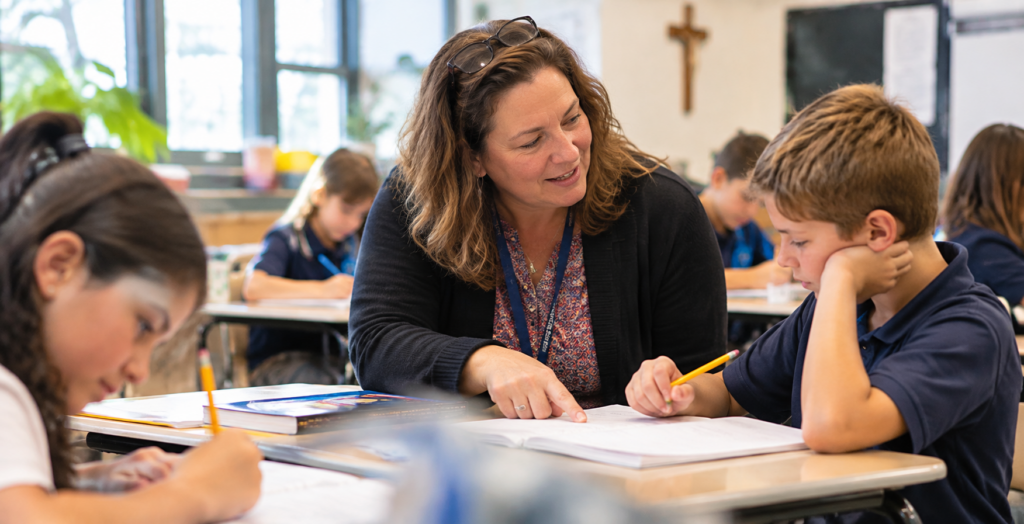
Practical strategies for building a coordinated approach to academic, behavioral, and social-emotional support.
When a student struggles academically, behaviorally, or socially, what happens next? Does the response depend on the teacher, the classroom, or the resources available?
Faith-based schools are deeply committed to meeting the needs of every learner, often while working with limited staffing, time, and specialized resources. But strengthening student support doesn’t necessarily require another program.
It starts with connecting the good work schools are already doing.
That was a central message of a recent webinar hosted by the National Catholic Educational Association (NCEA), featuring Julie Cantillon, Ph.D., Senior Vice President for Professional Learning at ADAC, and Joy Roberts, Ed.D., Co-Founder of Friendzy.
Together, they explored how faith-based schools can strengthen their Multi-Tiered System of Supports (MTSS) by connecting academic instruction, behavior, character development, and student well-being within a cohesive schoolwide framework.
MTSS: More Than a Three-Tier Model
MTSS is often represented as a triangle showing three levels of support: universal instruction for all students (Tier 1), targeted interventions for some students (Tier 2), and intensive individualized support when needed (Tier 3).
But effective MTSS implementation goes beyond identifying which students need additional assistance.
It requires shared instructional practices, clear processes for identifying student needs, regular progress monitoring, and meaningful collaboration among educators.
For faith-based schools, this approach reflects the mission of educating the whole child. Academic growth, character development, and student belonging are interconnected, not competing priorities.
Three Common Gaps in MTSS Implementation
During the webinar, Dr. Cantillon highlighted three challenges that frequently prevent schools from creating a coordinated system of student support.
1. No Clear Pathway for Support
When a student begins to struggle, teachers need to know who to contact, what information to gather, and what happens next. Without an established process, support can depend on which teacher identifies the concern.
2. Inconsistent Practices Across Classrooms
Students benefit from shared expectations, instructional strategies, and common language across grade levels. Schoolwide professional learning helps educators establish a consistent foundation while meeting individual classroom needs.
3. Disconnected Interventions
A student may receive targeted support outside the classroom, but if intervention providers and classroom teachers aren’t communicating, those strategies may not transfer to everyday learning. Shared goals and regular collaboration help connect support across settings.
These challenges aren’t necessarily the result of insufficient effort. They often reflect opportunities to strengthen schoolwide structures and coordination.
A Practical Five-Step Pathway for Student Support
Dr. Cantillon shared a straightforward process school teams can use when a student needs additional support:
Identify: Use observations, assessment data, and family input to define the specific need.
Select: Choose an evidence-based intervention aligned with that need.
Assign: Clarify who will provide support, when it will occur, and how responsibilities will be shared.
Monitor: Establish measurable goals and review student progress regularly.
Review: Determine whether to continue, adjust, intensify, or gradually reduce the intervention.
This approach moves schools from informal conversations about student concerns to intentional, coordinated action.
Connecting Academic Learning, Behavior, and Belonging
Students don’t experience academic, behavioral, and social-emotional needs in isolation.
A student struggling with reading comprehension may also experience frustration during group activities. A student who avoids participating may need both instructional support and help navigating peer relationships.
During the webinar, Friendzy demonstrated how faith-based character education and proactive teaching of emotional regulation, relationships, and conflict resolution can strengthen universal Tier 1 supports.
ADAC helps schools connect these practices to the larger structures needed for effective MTSS implementation, including leadership, professional learning, collaborative planning, and data-informed decision-making.
Together, these approaches reinforce an important principle: Students benefit when the adults supporting them use consistent language, shared strategies, and coordinated processes.
Where Should Faith-Based Schools Begin?
Schools don’t need a large MTSS team or an entirely new set of programs to get started.
An existing student support team may already provide the foundation. The first step is identifying current strengths, recognizing gaps, and establishing realistic priorities.
Strengthening Tier 1 instruction, creating consistent practices across classrooms, and establishing clear pathways for intervention are valuable starting points.
ADAC partners with faith-based schools and school systems to provide customized MTSS professional learning that helps educators connect existing initiatives, strengthen instruction, and build sustainable systems of student support.
Whether your school is beginning its MTSS journey or looking to strengthen existing practices, ADAC can help you take the next step.
Explore ADAC’s MTSS Professional Learning Workshops
Watch the Webinar Recording
Thank you to Friendzy for partnering with ADAC and to NCEA for hosting this important conversation.
Watch the full webinar, Integrating Social, Emotional, & Behavioral Supports into MTSS: A Practical Catholic School Framework, to hear Julie Cantillon and Joy Roberts share strategies for supporting every learner.